

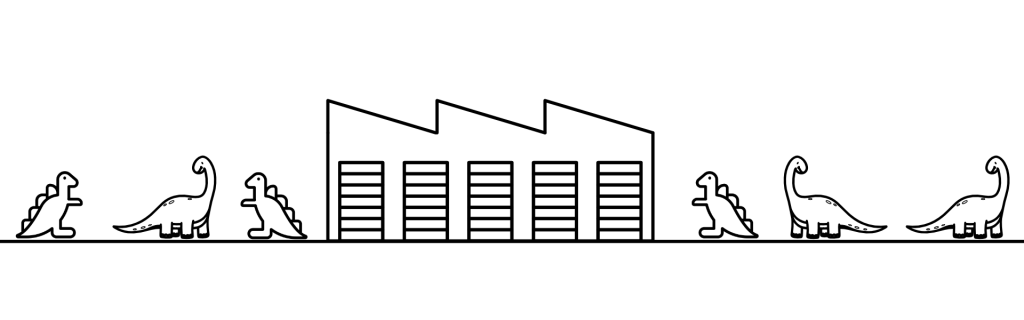
The news is full of stories of the massive build-out of AI data centres- with the focus on issues such as energy, environment, community, resources, semiconductors and even the bond & equity markets.
Given massive capital outlay coupled with scary depreciation, rapid technology obsolescence and high running costs, the economics seem to be based on wild optimism on future revenue more than anything else.
Basically: your datacentre needs to make a big pile of money within just a couple of years, after that, the asset is a very large shed containing copper & a lot of A/C gear, with some very angry neighbours.
Bigger & bigger

Much of this growth is driven by ever-larger LLMs, which can do everything from write code to the best chicken jalfrezi recipe. We are beyond calling them ‘large’ language models.
I’d say FGLM is a better acronym, with the G meaning gigantic.
The prevailing approach is to throw massive amounts of processing power at the problem- measured in data centres using terawatts of electricity.
It’s a bit like thinking the way to win a car race is a bigger engine.
Australian motorsport followers will remember the Morris Mini Cooper S humbled the American V8s at Bathurst. It was so embarrassing that they changed the rules to favour the muscle cars.
Then the Nissan GT-R did the same thing- but I digress.
WTF were we thinking ?
I think in a few years, these data centres will be seen as dinosaurs from an age of incredible enthusiasm, but with bonkers results.
Extending the automotive analogy, the future of AI is likely more the Colin Chapman philosophy of ‘simplify then add lightness’ rather than a brute-force approach of bigger models and more power.
This means the focus will shift to efficiency- so AI that runs on a sprinkle of energy on a mobile device, rather than in a datacentre needing it’s own nuclear power reactor.
Instead of relying on highly unpredictable and expensive AI token consumption- businesses will move towards cost-effective and efficient AI solutions, probably leveraging their own training data, rather than generic, commodity models which are available to all competitors.
Cheap and efficient ‘good enough‘ open weight models will be used by most businesses and individuals, with the hugely expensive frontier models limited to very specific tasks.
AI models and training data will be seen as valuable business assets and a key competitive advantage- not stuff you buy from someone else. How and where the AI is applied is far more important than the sophistication of the model.
Rather than FGLMs that do more and more, there will be specialised, lightweight models that excel at specific tasks (a bit like humans), with an orchestrator to send each task to the best model.
After all, a microbe can carry out a certain amount of ‘compute’ using a miniscule amount of energy. The human brain uses something like 20 watts of power.


.jpg)
You must be logged in to post a comment.